Talks & workshops
Talks & workshops
Talks
I speak for museums, cultural institutions, cities, colleges and companies. Accessible and built on twenty years of practice and research. Themes I like to speak on:
- Open play versus gamification. Why points and badges reduce people to consumers, and what happens when you design play that doesn't have to go anywhere.
- Appropriation in public space. How interventions, installations and participation trajectories succeed because people can make them their own. Based on my PhD; earlier as the TEDxGhent talk Play Social in the City (2014).
- Designing and building with AI. What changes when a single designer can take a full product from concept to App Store — and what doesn't. Drawing on the practice of Imagoria.
A talk runs 45 to 80 minutes, tailored to your audience and context, in Dutch, English or French. Fee on request; I apply adjusted rates for cultural and non-profit organisations.
Workshops
Group cartography
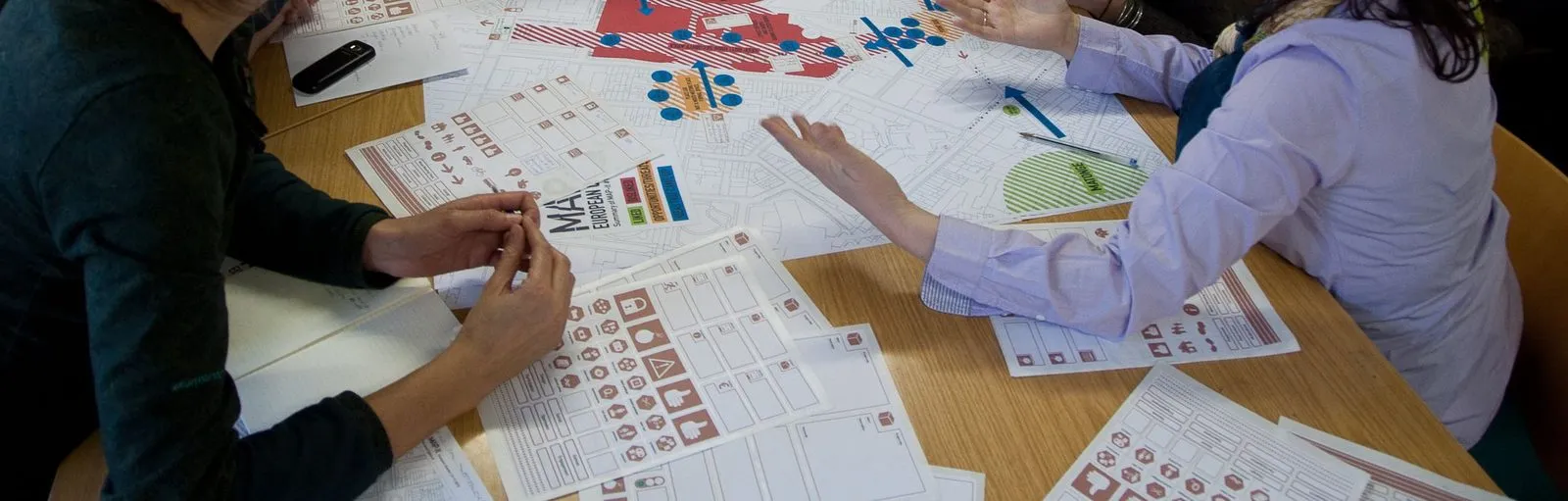
Every group carries a map inside it that no one has ever drawn: who does what, where things get stuck, what everyone finds important but nobody says out loud. In a group cartography session we put that map on the table. Literally: a large custom map, stickers and scenarios, on which everyone draws along. Placing a sticker takes less courage than defending an opinion, so even those who stay silent in meetings end up on the map. We look for where you agree — and just as hard for where you don't: difference isn't a problem to be smoothed away, it's information.
What it is not. Not a workshop with sticky notes and an action plan afterwards. I write no report and I do not tell you what to do: the conclusions are the group's too.
What you keep. The physical maps stay with you, followed by a drawn summary map with a short reading of what's on it. An image you made yourselves, not a text from me.
How it runs. First an intake conversation of an hour: what is going on, who is in the room, what it should yield. On that basis I build the scenario, the map and the stickers to measure. Then the session itself, two hours to half a day, with one facilitator per table of about eight participants. No presentation, no round of introductions: we start on the map straight away.
For teams that need to choose a direction and find they do not mean the same thing, organisations in transition where that change has no shape yet, neighbourhoods, associations and project groups where many parties have a say, and research groups mapping a complex field. From 6 to 24 participants, at your place or somewhere we choose together, in Dutch, English or French.
I work with MAP-it, the open participatory mapping method I co-developed at LUCA School of Arts / KU Leuven. The method is used by research groups at KU Leuven, UHasselt and LUCA, and by citizen collectives such as Les États Généraux de l'Eau à Bruxelles and CityMine(d). It is freely available under an open licence.
Making with technology
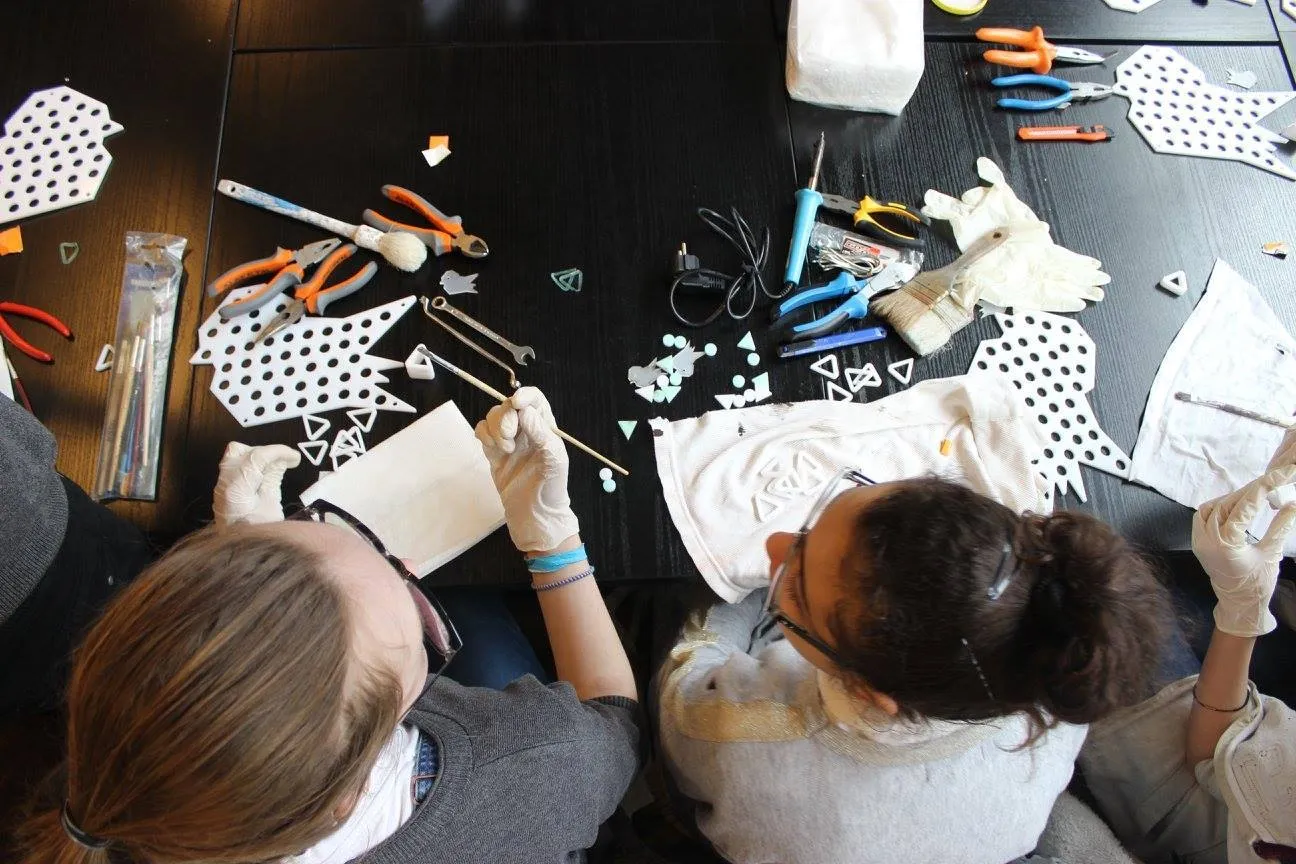
Sessions in which participants build something that lights up or responds: shapes cut from cardboard, perspex or textile, combined with LED strips, buttons and simple electronics. Soldering, acetone welding, bolts, glue gun. The technology stays deliberately small enough to learn in one session, so attention goes to the form rather than the manual.
I often put speculative fiction in front of it: participants first invent a creature, an animal or a future scenario for their street, and then build it. We described that combination of story and soldering iron in Fostering More-than-Human Imaginaries (NordiCHI 2020), written within SUCIB. Applied in Quand Les Zoziaux, Neighbourhood Light Choreography and specXcraft, among others.
It also scales up. With projection mapping, LED and laser the same approach grows to a facade, a square or a scenography: participants make the imagery, I make sure it lands on the architecture. We set the scale together, from one table to one street.
For schools, neighbourhood groups, makerspaces and teams. Works from around eight participants, and always produces something that can go outside.
Co-creation trajectories
Multi-day or spread-out trajectories in which stakeholders design along instead of reacting afterwards: from prototyping sessions such as the co-design trajectory with LUCA students for the Bruegel Game to speculative making sessions as in specXcraft. Set-up tailored after an intake conversation.